






Deeper Dive Series
Carolina Day - Celebrating since 1777!
by JoAnn Zeise, Curator of History
Before you grab your American flags next weekend – grab your palmetto-themed items and celebrate Carolina Day! This day commemorates the Battle of Sullivan’s Island, the first great victory for the American forces against the British. The battle took place on June 28, 1776 – just a few days before Congress adopted the Declaration of Independence – and has been celebrated since 1777.
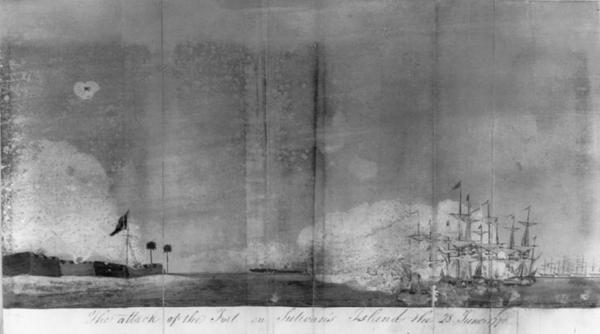
Attack on the fort on Sulivan’s Island the 28 June 1776 / painted by Henry Gray. Courtesy of Library of Congress.
As all South Carolina schoolchildren learn, the palmetto logs of hastily-constructed Fort Sullivan withstood a withering barrage from British warships. Tradition says the cannonballs bounced off the fort – but it is more accurate to say the palmetto logs and sand absorbed the bombardment. Leading the American forces at Fort Sullivan was Col. William Moultrie. He had only 31 guns at his disposal, but they inflicted considerable damage. Moultrie concentrated fire on the British’s two largest ships and used hot shot – heated metal balls that could set ships on fire. American defenses on Sullivan’s Island also thwarted a British amphibious assault of more than 2,500 soldiers and marines.
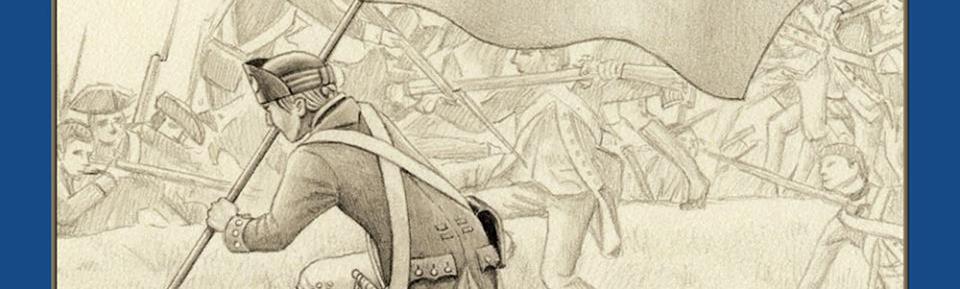
For a moment the British thought they had the upper hand when the fort’s flag came down. The flag was dark blue with a gorget design in the upper left-hand corner (or crescent moon, but that’s a discussion for another blog). The flag’s mast had been broken and it fell directly into an open area after taking the full blast of British fire. Sgt. William Jasper bravely leapt from an embrasure to retrieve the flag. He attached it to a makeshift mast and it once again flew over the fort – no doubt to the disappointment of the British. The battle was over by sundown and the flag, with the addition of the providential palmetto tree, became the state flag of South Carolina.

SC 2nd Rgt. Flag
Flag of the 2nd SC Regiment.
Accolades for the Sullivan’s Island defenders quickly followed after the battle. On July 1, Fort Sullivan was renamed Fort Moultrie, and that same day the Second Regiment, which participated in the battle, received two flags from Suzanne Elliot. One of those flags is now jointly owned by the South Carolina State Museum and the Smithsonian National Museum of American History. Every five years it is on display here at the State Museum.
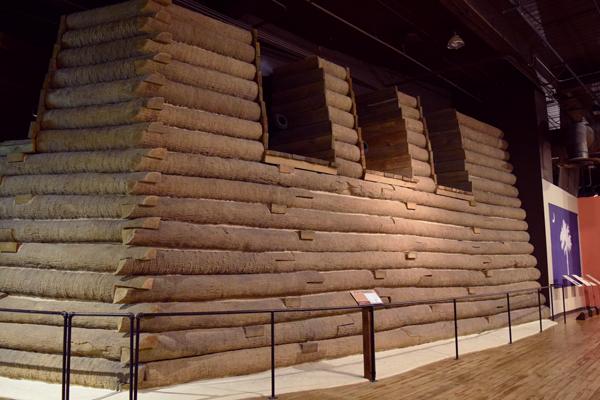
Fort Moultrie replica on display at the SC State Museum.
To celebrate the victory, the people of Charleston marked the anniversary one year later – and the commemoration continues to this day as Carolina Day. In the past it has been known as the Anniversary of the Battle of Fort Moultrie, Palmetto Day, and Sgt. Jasper’s Day. In 1875 it began being referred to as Carolina Day. The commemoration usually includes artillery salutes, militia demonstrations and parades. The day is marked with the bells of St. Michael’s Episcopal Church playing “Three Blind Mice.” Legend has it this was the only tune the message runner knew how to play when he was spreading the word about the victory.
In the 1800s the celebrations took place in the public square in Moultrieville on Sullivan’s Island. In 1851, only 10 years before the Civil War, revelers ferried out to the island but were told by the Federal troops in the fort that they could not enter. Their party continued back in Charleston, but that evening the Palmetto Guard militia unit was formed to ensure rights of South Carolina would always be protected.